
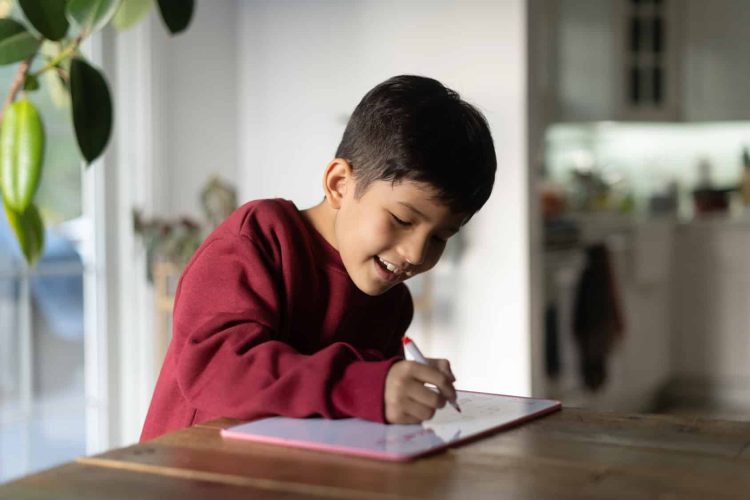
Some kids can tell you a whole story out loud but freeze the moment they have to write it down. Often, the reason is dysgraphia, a specific learning disability that interferes with a child’s ability to learn written language and use it to express their thoughts, as described by the International Dyslexia Association. It can affect spelling, letter formation, spacing, fine motor coordination, writing speed, grammar, and composition. There are two forms. Acquired dysgraphia develops when a brain injury or neurologic disease disrupts skills a person already had. Developmental dysgraphia, the form seen in children, means a child struggles to learn to write despite good instruction and normal cognitive ability, as explained in this clinical review.
The Three Types of Dysgraphia
There are three subtypes of dysgraphia, and they look different in practice. Graphomotor dysgraphia affects the physical act of writing. The child knows exactly what they want to say, but the brain struggles to signal the hand to form letters on the page. Watch for an awkward pencil grip, such as holding the pen too tightly or in an unusual way; handwriting with wildly inconsistent letter sizes, shapes, and spacing; and mechanics that never settle, like mixing print and cursive or drifting off a straight line.
Dyslexic dysgraphia shows up most in spontaneous writing, meaning anything a child produces without tracing or copying. That writing is often severely illegible and tends to get worse the longer a session goes on. Spelling is notably poor, both on paper and out loud. Here is the telling detail: fine motor skills are fine. The same child can trace, draw, or copy existing text without much trouble.
Executive dysgraphia is about the thinking side of writing rather than the mechanics. Handwriting itself is often fine, but planning, organizing, and sequencing thoughts on paper is hard. These kids may lose an idea mid-sentence because working memory gives out, struggle to structure a cohesive essay or a solid topic sentence, or never quite master the unspoken rules of grammar. This type also frequently co-occurs with ADHD and can appear alongside broader language processing differences.
How Common Is It, and What Causes It?
Writing struggles are more common than most parents realize. Studies estimate that between 10% and 34% of school-aged children experience handwriting difficulties, and the rate may run even higher among kids with developmental coordination disorder or other neurodevelopmental disabilities. In other words, plenty of children struggle with handwriting, and those struggles can chip away at both grades and self-esteem.
Why does it happen? A mix of factors. Genetics play a role: researchers have linked genes on chromosome 15 to poor reading and spelling, and genes on chromosome 6 to phonemic awareness. Environment matters too, since socioeconomic pressures and limited access to educational resources can make writing difficulties worse. And conditions tend to travel together: children with ADHD show a higher incidence of writing problems, a reminder of how connected cognitive and behavioral factors really are.
When Struggling Turns Into Giving Up
Here is where the emotional piece comes in. When a child tries hard at reading and writing and keeps coming up short, they often develop what psychologists call learned helplessness. Repeated failure, or a repeated lack of control, teaches a student that effort doesn’t matter, and that lesson leads to disengagement, emotional distress, and reduced learning, even when support finally arrives. It takes hold when kids experience repeated failure, unpredictable or inconsistent feedback, criticism unrelated to effort, and systems where trying does not reliably lead to success. Instead of believing “I need a different strategy,” the belief becomes “nothing I do will work,” “I’m bad at this,” and “why try?”
At school, learned helplessness looks like avoiding challenging tasks, giving up quickly or not starting at all, negative self-talk (“I’m dumb,” “I can’t read”), leaning hard on adults or refusing to ask for help, and grades that slide over time. The research here is sobering. Learned helplessness predicts lower future academic achievement even after controlling for ability, and it deepens when students face ongoing academic stress without enough support. It is strongly tied to depression, anxiety, test anxiety, low self-esteem, and reduced resilience. Neuroscience research even shows it changes how the brain responds to challenge, ramping up the threat response while dialing down the executive control needed for active coping. That makes this especially relevant for students with dyslexia, dyscalculia, dysgraphia, ADHD, and emotional or behavioral disorders. Trying hard and failing, over and over, can quietly teach a child that effort is pointless. Over time, academic difficulty turns into emotional distress, school avoidance, and flagging motivation even when instruction improves. That is why addressing the learning difficulty and the child’s emotional experience together is so important.
What Parents May Notice at Home
Parents usually see it before anyone names it. Your child may give up easily or refuse to try, say negative things about themselves (“I’m dumb” or “I hate school”), seem anxious or shut down about schoolwork, avoid challenging tasks even when they are capable, and need constant reassurance or adult help. Remember: this is an emotional response to repeated difficulty, not a choice.
The Good News: It Can Be Unlearned
The good news? Learned helplessness is learned, which means it can be unlearned. Kids recover when effort clearly connects to outcomes, when strategies are taught explicitly, when feedback is predictable, and when they get real chances to experience control over their own learning. That is exactly why explicit instruction, scaffolded success, and strength-based feedback matter so much in school psychology and special education.
Helping a student out of learned helplessness comes down to restoring their sense of agency and breaking the cycle of failure. Teachers can break large assignments into manageable chunks, grade effort alongside accuracy, ask students to make an independent attempt before seeking help, and treat mistakes as a normal part of learning. Small structural changes help too: tailor early assignments so success is genuinely achievable, allow multiple attempts on quizzes and record the best score, and give students a toolbox of resources, such as step-by-step notes, anchor charts, or video tutorials, to consult before raising a hand. Personal whiteboards let a child show the teacher exactly where they got stuck instead of saying “I just don’t get it.” Mindset matters as much as mechanics. Build a classroom culture where errors are neutral data, praise the hard work and strategies a student used rather than fixating on the final grade, and use collaborative challenges where small groups depend on each other. Watching their own contribution move a group toward its goal is often what convinces a struggling child that effort counts after all.
To discuss further, please contact our office at 216.716.5630.